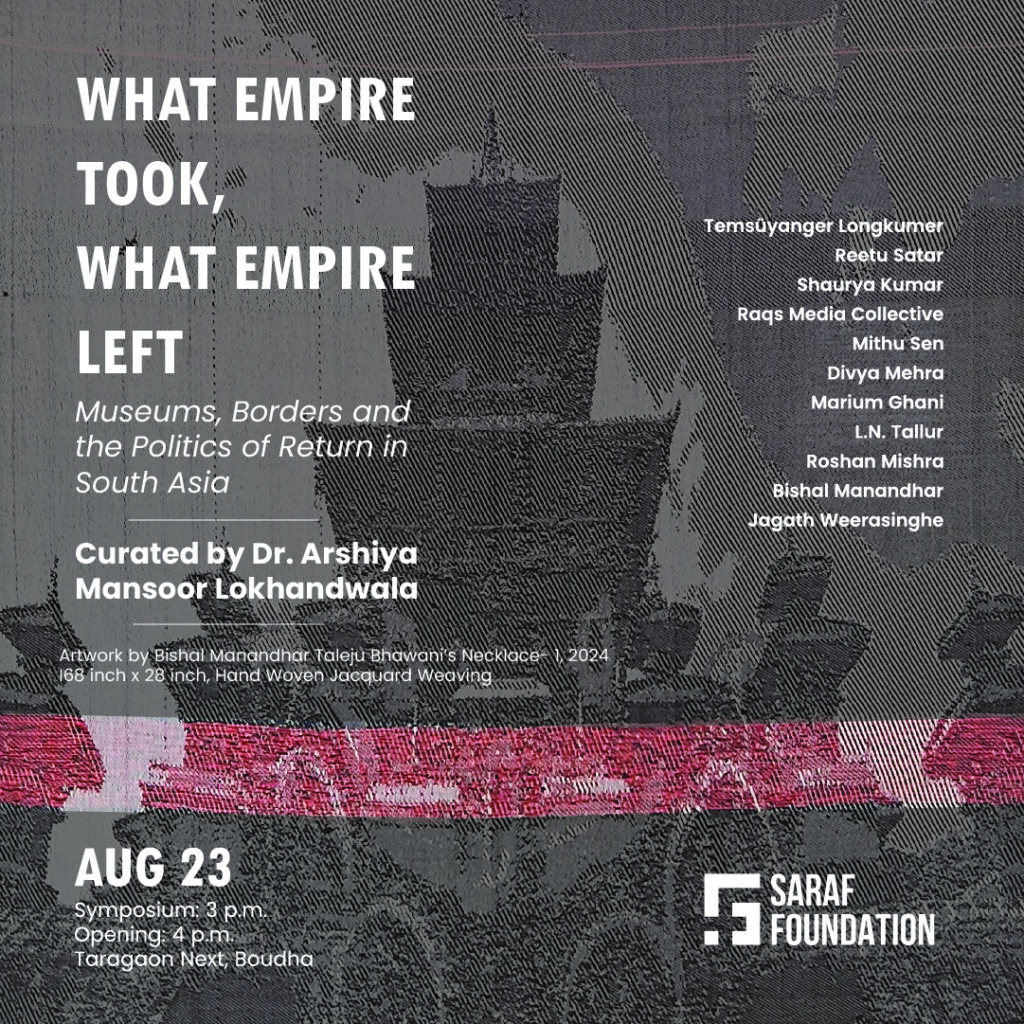
Temsüyanger Longkumer, Reetu Sattar, Shaurya Kumar, Raqs Media Collective, Mithu Sen, Divya Mehra, Marium Ghani, L.N. Tallur, Roshan Mishra, Bishal Manandhar, Jagath Weerasinghe
What Empire Took, What Empire Left emerges from a central provocation: what happens when the sacred is violently dislocated—not only from place, but from time, ritual, and meaning? Across South Asia, deities, manuscripts, and ritual objects have been removed from living contexts and reclassified within Western museums, where they are aestheticized, contained, and severed from the cosmologies that once animated them. This exhibition confronts that rupture.
Rather than simply narrating histories of loss, it interrogates the conditions that enabled such displacement—colonial epistemologies, illicit markets, institutional complicity, and the enduring frameworks of museology that privilege possession over presence. From Nepal’s emptied temples to the dispersal of India’s bronzes, from Gandharan sculptures in Pakistan to the systematic erosion of Bangladesh’s terracotta heritage, the exhibition traces a region-wide history of cultural dismemberment.
Yet this is not a lament. Through contemporary artistic practices, What Empire Took, What Empire Left activates a counter-archive—foregrounding acts of return not only as restitution, but as epistemic resistance. It calls for a rethinking of South Asian art history itself: not as a neutral canon of objects, but as a field marked by violence and in urgent need of decolonial reparation, where memory, belief, and sovereignty are reclaimed.
View the Curatorial Note here.
View the catalogue here.
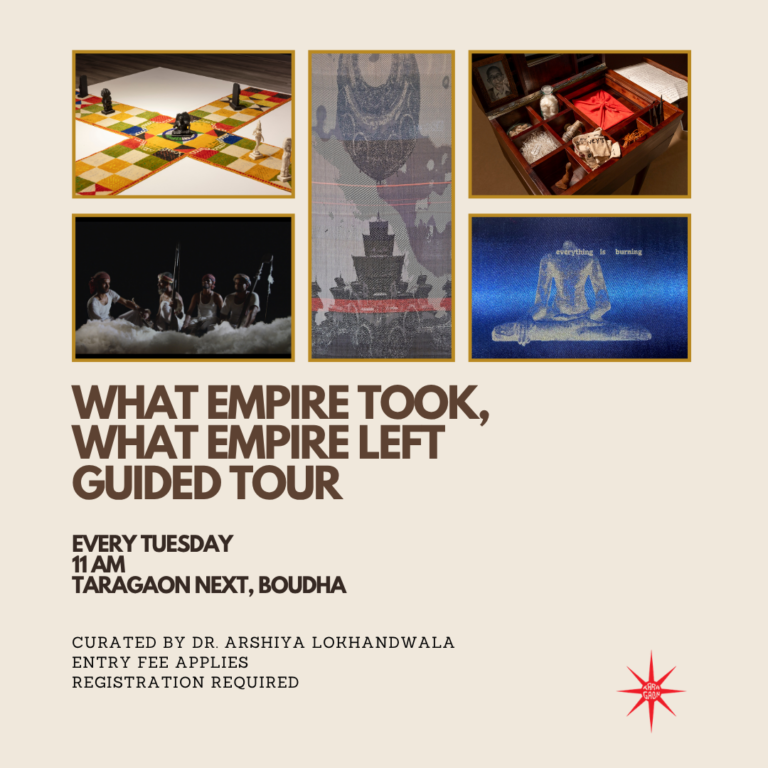
Weekly on Tuesdays at 11 a.m.
Why should be part of a guided tour for this exhibition?
- Learn about the significance of preserving our heritage and identity.
- Understand the reality of how our heritage was/is being occupied by the museums in the west.
- Expose them to the artworks created by different South Asian artists which helps to enhance their critical thinking and different forms of art.
What Empire Took, What Empire Left emerges from a central provocation: what happens when the sacred is violently dislocated—not only from place, but from time, ritual, and meaning? Across South Asia, deities, manuscripts, and ritual objects have been removed from living contexts and reclassified within Western museums, where they are aestheticized, contained, and severed from the cosmologies that once animated them. This exhibition confronts that rupture.
During this reading, we will be understanding and learning about the stolen artifacts in western museums and repatriation efforts made by the countries to bring them back home.
All the readings will be sent to you after your registration.
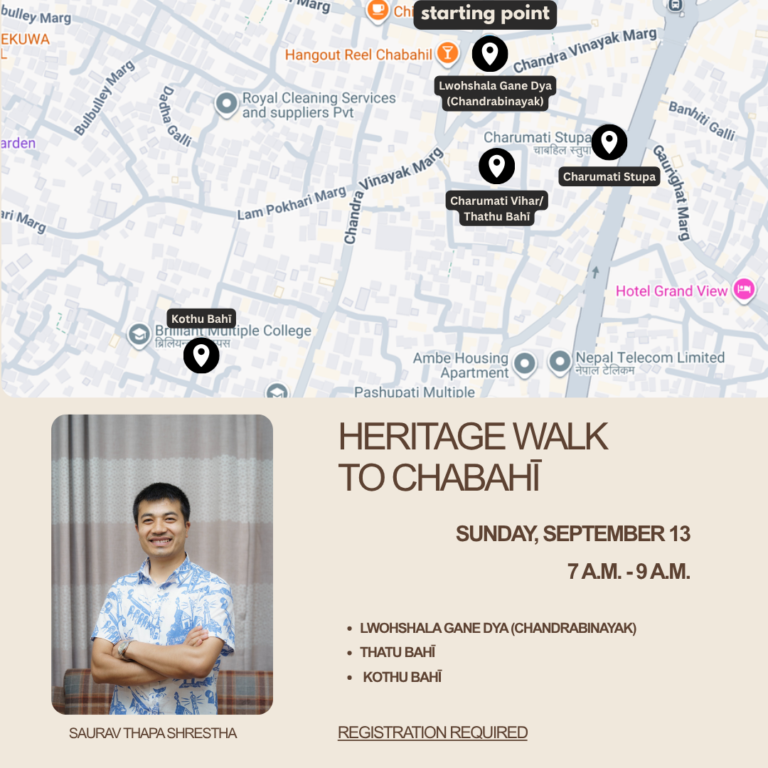
September 13: Heritage Walk to Chabahī
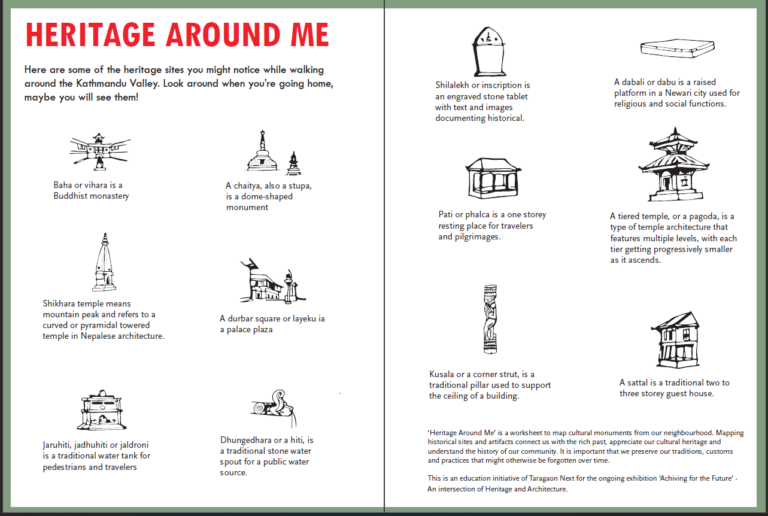
An updated version of our old worksheet, 'Heritage Around Us' has been made available again for young learners to take away and explore spaces around the valley and be able to identify our heritage spaces.
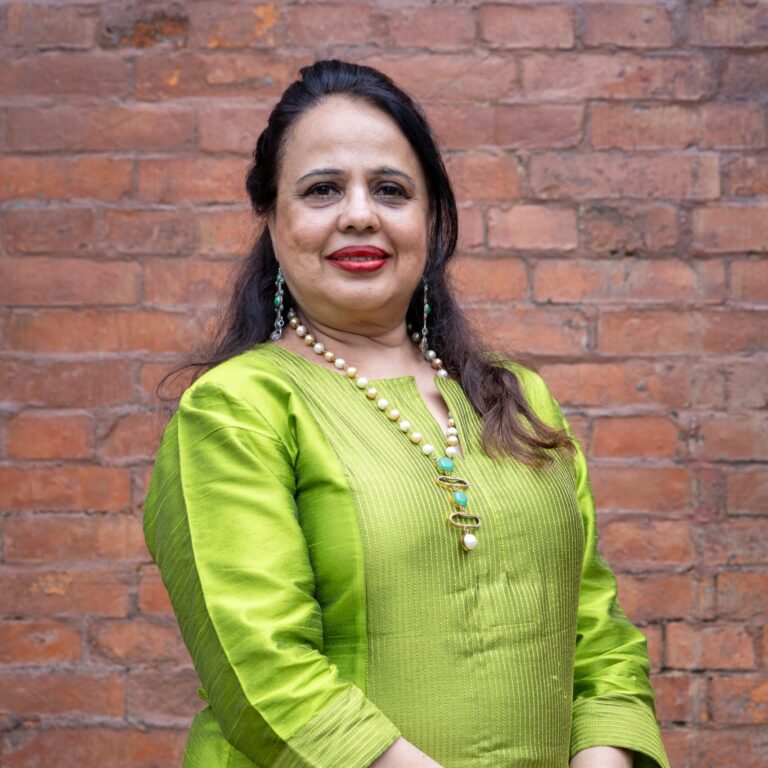
Dr. Lokhandwala is an art historian, curator, and founding director of Lakeeren Gallery, Mumbai. Her notable curatorial projects include Prussian Blue: A Serendipitous Color that Altered the Trajectory of Art (KNMA, 2023), The Archaeology of the Self: Archives, Anarchives and the Artist (2023 amongst others. Her exhibition Re-Worlded: Seventy Years of Investigating a Nation (2017) earned her the Curator of the Year Award by India Today. She has also curated After Midnight: Indian Modernism to Contemporary India 1947/1997 at the Queens Museum (2015). Since 2019, she has lectured at the Art Institute of Chicago, teaching South Asian Art and Postcolonial Studies. With over 300 curated exhibitions, Dr. Lokhandwala writes extensively on globalization, feminism, and postcolonial studies.