Curator's Note
Bādal unfolds as a contemplative exploration of water, understood not merely as an
element but as a living and thinking force, one that moves, heals, renews,
recomposes, and remembers. It connects sky and earth, flows between visible and
invisible realms, and sustains both material life and spiritual imagination.
In the Kathmandu Valley, this relationship between water, sky, spirituality, and
community has long been expressed through rituals and seasonal cycles. The
worship of Indra and the chariot festival of Rato Machhindranath invoke the rains
essential for cultivation and renewal, reminding communities that water is a divine
blessing that sustains life. These cosmological ideas are also embedded in the visual
language of the Valley’s art and architecture. Medieval motifs such as Kirtimukhas,
Nagas, and Makaras, carved into toranas and hitis, symbolically reflected the natural
cycle of water such as clouds rising, rains descending, rivers flowing, and water
retreating into the earth and sustained urban life in the Valley for centuries.
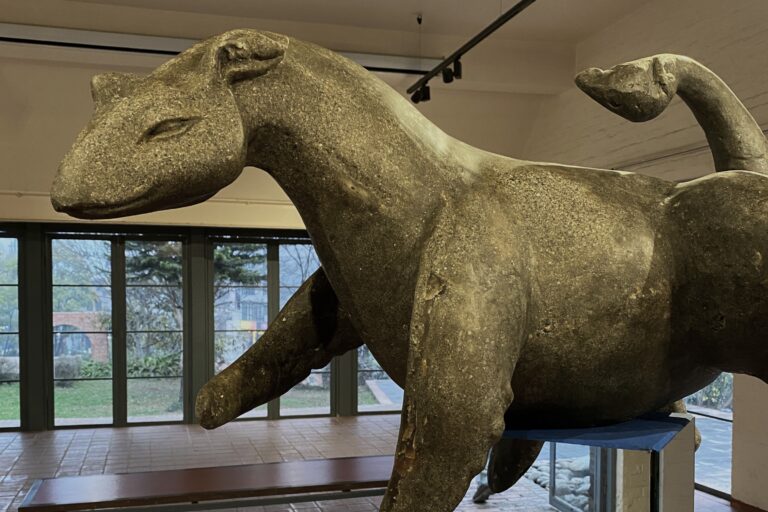
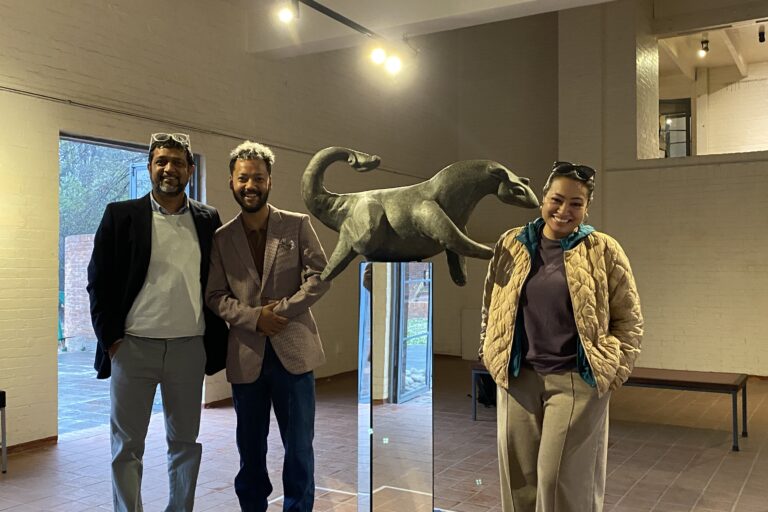
Sanjeep Maharjan imagines Bādal as a representation of this layered cultural
memory. The work presents an imagined creature that does not belong to any
specific myth or fixed cosmology, yet feels deeply familiar. Neither deity nor animal in
the literal sense, it inhabits a transitional space between the tangible and the
imagined. Shaped by inner perception rather than inherited mythology, the creature
becomes a vessel for the water element. The sculpture is composed of sand and
resin that give the form a tactile presence while evoking the fluid and shifting
qualities of water.
The creature emerges as a quiet embodiment of the water body and its enduring
continuity. Bādal also resonates with the artist’s ongoing Varuna series, where the
water element is explored through symbolic foliage and lyrical patterns inspired by
South Asian iconography. Such motifs have historically appeared across temples,
domestic spaces, and public sites in the Kathmandu Valley, subtly marking the
presence of water and its deity in everyday life. In this work, those inherited visual
memories are extracted and reimagined. Rhythmic curves, flowing contours, and a
sense of weightless balance echo the iconographic traditions of clouds, rivers, and
celestial waters, while remaining grounded in contemporary simplicity.
By envisioning a new mythical form and tactile presence, Maharjan affirms water as
a compassionate and connective force, one that oscillates between inner and outer
worlds, between tradition and imagination. Bādal thus becomes an invitation to
pause and reflect on water as cultural memory, spiritual connector, and a quiet
teacher of balance and continuity in a rapidly shifting culture.